The AI panic is real. Your LinkedIn feed is flooded with doomsday predictions. Entire industries are supposedly "at risk." Executives are scrambling. But here is what I have learned from 23+ years of recruiting at Google and Indeed: the companies and individuals thriving right now are not the ones hiding from AI. They are the ones who have already moved.
The real threat is not artificial intelligence. It is your refusal to evolve.
The Story Everyone Is Getting Wrong
Let me be direct. AI tools will absolutely replace certain tasks, workflows, and yes, even job functions. That is not pessimism. That is math. When a tool can do something faster, cheaper, and better, organizations adopt it. This happened with spreadsheets. It happened with email. It is happening with AI.
But here is the part nobody talks about: new capabilities always create new value. The companies hiring aggressively right now are not hiring fewer people. They are hiring different people. People who know how to leverage AI instead of compete with it.
The distinction matters enormously.
I worked with a financial analyst recently who was convinced her role would "disappear" within 18 months. Her peers were panicking. Within six months, she had integrated AI tools into her workflow so effectively that she was producing six months of insights in six weeks. Her company did not lay her off. They promoted her and created a new role specifically designed around her AI-augmented capabilities. Her peers? Still anxious.
The difference was not her technical background. She had none. The difference was her willingness to move first.
Why Positioning Is Now Survival
This is where the SSIP framework becomes critical: Story, Skills, Impact, Positioning. Historically, positioning was the final piece you refined during a job search. Now it is foundational. It is the thing that determines whether the market sees you as essential or expendable.
Your positioning must answer this question clearly: What value do I create in a world where AI handles routine work?
If you cannot answer that in one sentence, you are in trouble. Not because AI is coming for you. Because the market has not yet understood what you actually do.
The people protecting their careers right now are not the ones working harder on their current skills. They are the ones who have made themselves visible as strategic thinkers, problem solvers, and judgment makers. They have updated their LinkedIn to reflect how they use AI as a force multiplier, not a threat. They have told new stories about impact in client conversations. They have reorganized their positioning around what humans uniquely do: context, strategy, relationships, and creativity.
If your positioning still sounds like it did in 2024, you are already losing ground.
The 48-Hour Activation Protocol for Right Now
This is not theoretical. Here is what I want you to do immediately:
- Audit your current role ruthlessly. Which parts could an AI tool reasonably do? List them. Do not hide from this. This is intelligence gathering, not surrender.
- Identify your irreplaceables. What do you do that requires judgment, relationships, client knowledge, or strategic thinking? What would collapse without you? That is your future.
- Spend six hours this week learning one AI tool that is relevant to your industry. Not to become an "AI expert." To become someone who works alongside AI as a standard part of the job.
- Update your LinkedIn profile. Change your headline and summary to reflect how you are positioned for AI-augmented work. Use language like "I leverage AI to..." and "I strategically apply AI tools to..." Specificity matters.
- Have one conversation. Reach out to someone in your network doing similar work. Ask them directly: "How are you thinking about AI in your role?" Listen for what is shifting. Listen for what they are actually doing differently.
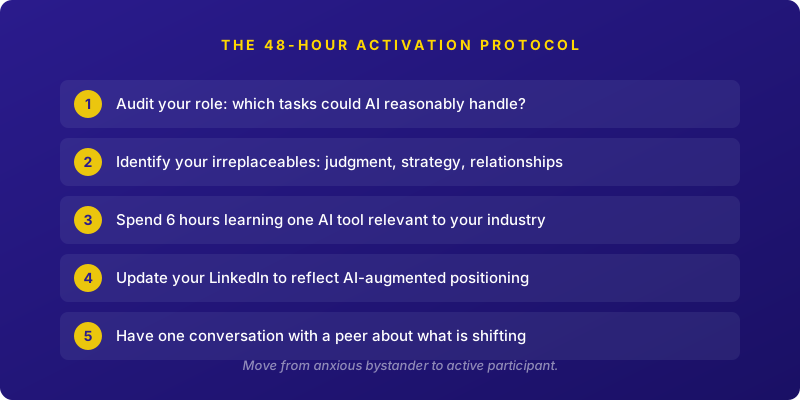
That is it. 48 hours. This is not about becoming a data scientist. It is about moving from anxious bystander to active participant.
Career Assurance Means Adaptation
Career assurance is not a safety net you build once and forget. It is a practice of continuous evolution. The people with real assurance right now are not the ones with the most impressive titles. They are the ones with the most adaptable skill sets and the clearest story about why they matter.
Here is what that means practically: your value proposition has to update at least twice a year now. Not every year. Not when you change jobs. Twice a year, minimum. As the market shifts, so does what makes you irreplaceable.
If you have been at the same company for five years telling the same story about your impact, you are not stable. You are invisible. And invisibility is exactly the vulnerability that makes career disruption hit hardest. This connects directly to the loyalty tax: staying in one place too long increases your risk profile. You become a specialist in one company's problems instead of a strategist who can solve problems anywhere. In an AI-accelerated economy, generalists with clear positioning win.
Your career assurance does not come from staying exactly as you are. It comes from becoming the person AI actually needs in the room. That person is strategic, adaptable, and visible.
Move Before You Have To
The window is open right now. This is not a crisis. This is an advantage moment.
Companies are actively hiring for people who understand AI integration. They are paying premiums for people who can lead teams through technological transition. They are seeking people who can bridge human judgment and machine capability. And if you are wondering whether the compensation reflects this demand, the leverage you need starts being built now, not at the offer.
If you wait until your role is fully automated to act, you are behind. If you move now, you are ahead.
That means updating your skills in public (share what you are learning), clarifying your positioning in every conversation, taking on projects that have AI integration built in, and volunteering for the cross-functional work that is usually seen as "extra." These are not "AI jobs." They are just jobs with a new infrastructure. And the people positioned to lead them are the ones who moved first.
The companies and people winning right now made their move. It is your turn.
Ready to Position Yourself for the AI Economy?
Book a Strategy Briefing. We will audit your current positioning and build a narrative that makes you essential, not expendable.
BOOK YOUR CALL