I have a client. Senior consultant at EY. Ten years in. Strong track record. The kind of professional who delivers. Last promotion cycle, she was passed over for Managing Director. No explanation. No roadmap to get there. Just. Not. Yet.
Now she is scrambling. LinkedIn updated last week. Resume dusted off two days ago. She is reaching out to people she has not talked to in five years. She is taking recruiter calls. She is panicking because she realizes something too late: nobody outside EY knows who she is. Her network is one company deep. Her personal brand is invisible. Her positioning is nonexistent. And now she needs all of it urgently.
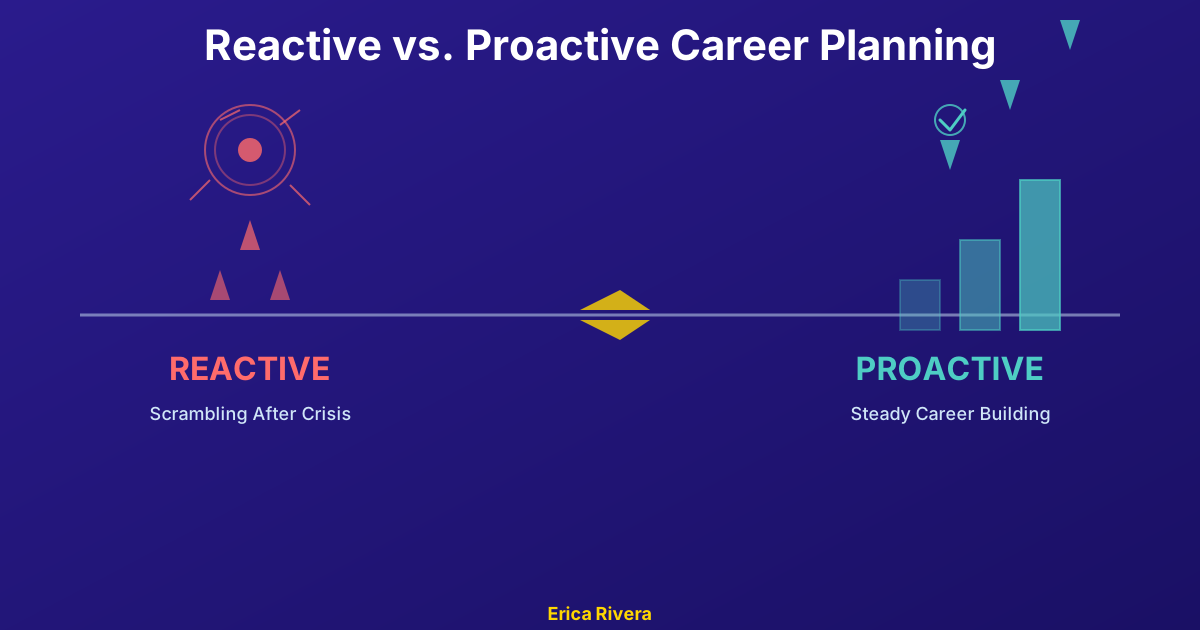
This is the cost of waiting. Not the cost of being patient. The cost of not building your career infrastructure while you still have the option to build it strategically instead of desperately.
Why Reactive Career Management Always Loses
Career crises come in different shapes. Passed-over promotions. Organizational restructuring. Leadership changes. The industry pivot you did not see coming. A manager who does not believe in you. Whatever the trigger, the timeline is always the same. You need to be market-ready. You need it now. You need it because you have no choice.
By then, you are starting from zero. Your resume has not been updated in three years. Your LinkedIn is a time capsule of old titles. Your external network has gone quiet. You have no active conversations with recruiters. You have no proof points of where you stand in the market. You have no alternatives lined up. You have vulnerability masquerading as an urgent job search.
The high-performers who weather career disruptions without chaos are not the ones who build their infrastructure during the crisis. They are the ones who built it before they needed it. They treated career assurance like insurance. Not because they were leaving. Because they were strategic enough to know that timing is not something you control.
The time to build your career brand is not when you need it. It is when you can afford to be patient about it.
The SSIP Framework: Your Career Insurance Policy
Career assurance is built on four pillars. Story. Skills. Impact. Positioning. Together, they form what I call the SSIP framework. And the magic is this: the best time to build SSIP is not during a panic. It is systematically, over time, when you can shape the narrative instead of react to it.
- Story. How do you explain who you are and what you do in a way that makes sense to the external market? Not internal politics language. Not your company's terminology. Market language. What you did. Why it mattered. What it proves about your capability. This takes time to craft. Not because it is complicated. Because it requires you to step out of your company's perspective and into the recruiter's perspective. If you wait until you need it, you will be thinking under pressure.
- Skills. The skills your company hired you for and the skills the market values for your next move may not be the same thing. You need to know what the market demands for your target role. And you need to map your experience to those demands in a way that translates across companies. This is not a two-day project. This is continuous translation work.
- Impact. You need proof points. Numbers. Scope. Influence. What did you build? What did you improve? What would have happened differently if you were not there? The executives who can articulate their impact clearly in a 15-minute recruiter call are the ones who kept documentation and thought about it strategically months before. Not the ones who tried to reconstruct their value proposition under deadline pressure.
- Positioning. How do you want to be seen in the market? What is your differentiation? What is the specific type of opportunity you are built for? Positioning cannot be done in a vacuum. It emerges from knowing your market, having conversations, testing messages. You cannot compress this into a two-week sprint when you need a job tomorrow.
Career Assurance Is Maintenance Work
The 48-Hour Activation Protocol is my way of describing what readiness actually looks like. It means that at any given moment, you could be market-ready in 48 hours or less. Not because you are actively job searching. Because you have maintained your career infrastructure continuously.
This is not about being disloyal to your current role. It is about being strategic about your future. Here is what maintenance looks like:
- Update your resume and LinkedIn quarterly, not when you need a job. Track your wins as they happen. Update your profile section descriptions. Keep it current with your actual operating level. By the time a crisis hits, your narrative is already documented.
- Take at least one recruiter call per quarter, even when you are not looking. This serves three purposes. You gather market intelligence about what is hiring and what compensation looks like. You stay visible to the search community. And you practice articulating your value under a low-stakes situation. If you only take recruiter calls when you are desperate, you will stumble.
- Maintain a living network outside your company. Not in a transactional way. Real relationships. Monthly coffee. Quarterly check-ins. Not because you need a favor. Because they are genuinely interesting to you. The difference between the person who has a warm network and the person who has to cold-outreach when crisis hits is everything.
- Do the market benchmarking work. Know what your role pays. Know what is hiring. Know what the skill gaps are between where you are and where you want to be. This is not something you do once. Market conditions shift. Salary bands shift. What is hot in recruiting shifts. Stay informed continuously, not desperately.
The False Choice Between Company and Self
I hear this objection constantly: "If I am doing all this career infrastructure work, is it disloyal to my current employer?"
The answer is absolutely not. And here is why. The best professionals are the ones who can commit fully to their role AND maintain market readiness at the same time. Those are not opposite positions. They are complementary.
When you know you are valuable outside your current role, you negotiate better internally. You do not accept substandard treatment. You do not stay in situations where you are not growing. You make strategic decisions instead of fearful ones. That makes you better at your current job, not worse.
When you are not afraid, you take risks. You drive bigger change. You speak up in meetings. You are not protecting your seat. You are protecting your value. That is the professional that organizations actually want to keep. The alternative is staying because you have no other option. And that person is fragile.
What This Actually Looks Like in Practice
Let us make this concrete. Three months from now, you should have:
- An updated LinkedIn profile that reflects your current operating level and articulates your SSIP framework clearly
- A resume that you are genuinely proud of, organized by impact, not job duties
- At least two to three recruiters who know you and have a sense of what you are looking for (even if the answer is "I am not looking")
- Five to ten people in your external network who you have talked to in the last 90 days about something real, not transactional
- A clear sense of your market value and where the opportunities are in your field
None of this takes hours per week. It takes strategic focus and consistency. And the return on this investment is massive. When a career disruption hits, you do not spiral into panic mode. You activate the infrastructure you already built. You have options. You have conversations lined up. You have proof of your value documented and ready. You have a network that knows you and believes in you.
You move from "I have to find a job" to "I have multiple paths I can choose." That is the difference between career assurance and career vulnerability.
Like I said at the beginning, the best time to build your career brand was yesterday. The second best time is today. And if you are serious about being ready before you need to be, here is where I help you build the infrastructure that creates options.
Ready to Build Your Career Infrastructure Before You Need It?
Stop waiting for the crisis to hit. Book a Strategy Briefing and let us build your SSIP framework and 48-Hour Activation Protocol now, when you can do it strategically.
Book Your Call